Verba Volant, Scripta Manent

Spoken words fly away, written ones remain

Author: Chris Obringer

  • Robinson family struggles

    I am comforted by the belief that every family history research progression runs into difficulties. However, I am beginning to think my difficulties may be too much to bear. I have run into a dead end in the research of the English branch of my family tree. Much of the difficulty comes from the cruel reality of how fleeting life was during the industrial revolution of the mid-19th century, and how tracing family history can be complicated by early deaths and missing records.

    My ancestor, Wilberforce Holden Robinson was born in a suburb of Manchester, UK, in 1858. This part of the story is well evidenced, by an official birth record form the General Register Office and Anglican Church records:

    Source: UK General Register Office
    Source: Anglican Parish Records (Manchester Cathedral and Manchester City Council)

    I have been able to document Wilberforce’s mother, Mary, quite extensively. She was born in 1821, in Thistleton, Lancashire. Her maiden name was Thompson. She married a man named Richard Robinson in 1837 and they had two children, Richard and Agnes. In 1847, Richard Robinson, Sr., died of a fever, while they lived in Little Bolton, Lancashire. Richard’s death was documented in two separate newspapers.

    In 1851, a census record indicated Mary lived in Southport, Lancashire, with her two children, Richard and Agnes. The record indicates she is a widow.

    The next records including Mary are the birth record and baptismal record of her sons, Joseph and Wilberforce, in 1855 and 1858. The father of the sons is Joseph Robinson. Yes, she had children with another Robinson.

    However, this is were I have a hole in my research. I can’t locate any marriage records for Mary and Joseph. I expected to find a marriage record in between the 1851 census record, and the birth of Joseph, Jr., in 1855.

    After the records referencing her sons, the next record I can find of Mary is another census record in 1861. This record again indicates Mary is a widow and lives in Blackley, Lancashire, with children, Agnes, Joseph, and Wilberforce. There is also another record in 1861 for Mary. This record is another birth record for a child of Mary’s, Alice.

    Source: UK General Register Office

    On this record, the father filed is left blank. It is not clear what the blank father field means. It could either suggest Mary did not know who the father was, or possibly that the father had died. This will have to remain a mystery. However, I feel like the latter explanation is more plausible due to the fact that the census record in that same year did not list Joseph and showed Mary was a widow. This would suggest Mary’s second husband, Joseph, died during 1860 or 1861, after the conception of Alice.

    This is the point of my search that creates frustration. I would like to identify Joseph Robinson. However, I can’t find any information on when or where he was born. I also have conflicting information about what his occupation was. On Wiberforce’s birth record Joseph is listed as a “Drysalter,” on Wiberforce’s baptismal record Joseph is listed as a “Builder,” and on Wilberforce’s later marriage record Joseph is listed as a deceased “Clerk in the Holy Orders.”

    Mystery remains, but I will continue the pursuit and discover the next branch of my Robinson family tree.
  • Catholic Expansion in the United States Documented Through Almanac Records, 1833–1853

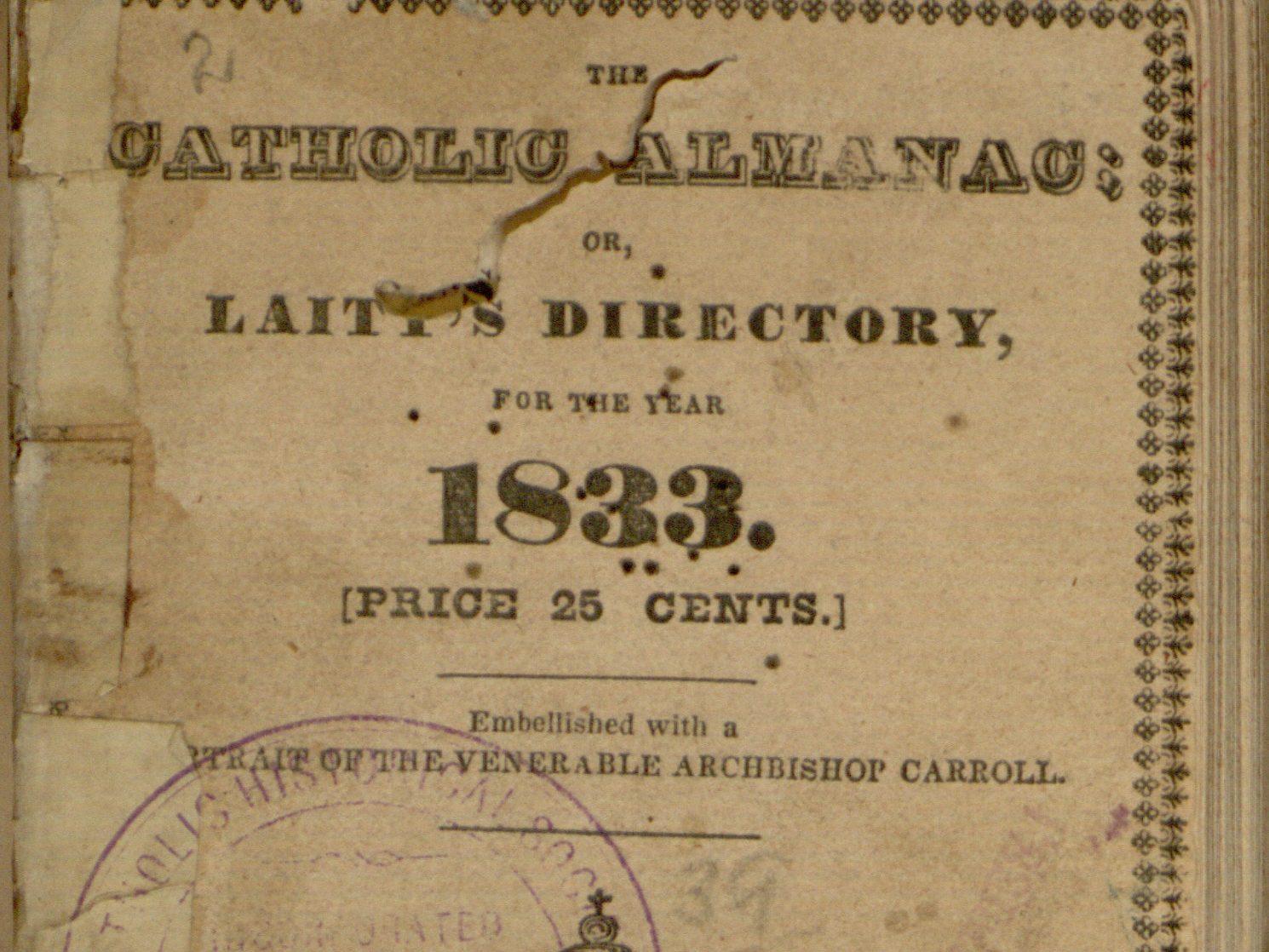
    The Catholic Almanac: or, Laity’s Directory, for the year 1833 https://digital.library.villanova.edu/Item/vudl:235594#?xywh=-1450%2C91%2C4628%2C2303&cv= by Digital Library@Villanova University under CC BY-NC-NC 4.0

    Between 1833 and 1853, Catholicism in the United States experienced remarkable growth, transforming from a minority faith into a significant religious force. This expansion, fueled by waves of Catholic immigrants, particularly from Ireland and Germany,[1] is vividly documented in the Catholic almanacs of the period. The 1833 United States Catholic Almanac, or Laity’s Directory, published by James Myers, and the 1853 Metropolitan Catholic Almanac, published by Fielding Lucas, Jr., provide detailed snapshots of this transformative era. Despite differences in publishers and the inevitable variation in methodology for collecting information, both almanacs were widely regarded as reliable by the public and ecclesiastical authorities, serving as trusted resources for tracking contemporary Church information and statistics.

    In 1833, the Catholic Church in the United States was still in its early stages of development, as documented in the United States Catholic Almanac. This almanac details a modest but growing network of dioceses, parishes, and institutions, comprising 264 churches and nine cathedrals. Many parishes, particularly in rural areas, relied on a single priest who served multiple congregations, holding services on designated Sundays. For instance, in Maryland, Rev. Francis Rolof alternated between locations like Bryantown and Zachiah to meet the needs of scattered communities. The almanac also highlights the significance of early Catholic colleges, such as St. Mary’s College in Baltimore and Georgetown College in Washington, D.C., which played a crucial role in educating Catholic youth and clergy. A total of seven colleges are recorded, laying the foundation for Catholic intellectual life.[2]

    By 1853, the Metropolitan Catholic Almanac showcased a remarkable expansion of Catholicism. While less detailed than the 1833 edition, likely due to the overwhelming growth in parishes and clergy, the 1853 almanac reports 1,545 churches, representing a 485% increase over the previous two decades. It also notes 34 dioceses, suggesting a 277% rise in cathedrals if each diocese had one constructed. Additionally, the number of colleges surged by 542%, reaching 45 institutions, referred to as “men’s literary institutions.” This growth reflects the Church’s response to massive immigration, particularly from Ireland and Germany, as well as the nation’s westward expansion, which necessitated the establishment of new parishes, dioceses, and educational facilities to serve a rapidly growing Catholic population.[3]

    In 1833, the United States Catholic Almanac lists dozens of churches across states, many of which were still under construction or served intermittently, such as the undedicated churches in Maine and Rhode Island. By 1853, the number of parishes had increased significantly, particularly in urban centers such as New York, Boston, and Philadelphia, where Irish immigrants were concentrated. The establishment of new dioceses, such as those in Monterey, CA, and New Mexico, Nebraska, and the “Indian Territory,” further underscores this expansion.

    The dramatic expansion documented in these almanacs, from rural mission churches to prominent urban cathedrals, was driven by the arrival of over a million Catholic immigrants, primarily from Ireland and Germany, between 1833 and 1853. These immigrants, fleeing famine and political unrest, established a lasting legacy by building vibrant Catholic communities despite fierce nativist resistance, including the 1834 burning of a Boston convent[4] and the 1844 Philadelphia anti-Catholic riots.[5] By 1853, these immigrant contributions had firmly rooted Catholicism in American society, with a network of parishes, schools, and colleges that endured as a testament to their faith’s cohesive communities and the organizational strength of Church leaders.


    [1] For Irish immigration see Margaret Mulrooney, Fleeing the Famine : North America and Irish Refugees, 1845-1851 (New York: Bloomsbury Publishing USA, 2003), xi, http://ebookcentral.proquest.com/lib/liberty/detail.action?docID=492149, and Ciarán Ó Murchadha, The Great Famine : Ireland’s Agony 1845-1852 (London, UNITED KINGDOM: Bloomsbury Publishing Plc, 2013), 160-61. http://ebookcentral.proquest.com/lib/liberty/detail.action?docID=5309713, for German immigration see Farley Grubb, German Immigration and Servitude in America, 1709-1920 (Oxford, UNITED KINGDOM: Taylor & Francis Group, 2011), 410-11, 13. http://ebookcentral.proquest.com/lib/liberty/detail.action?docID=1099479.

    [2] The United States Catholic Almanac, or, Laity’s Directory, for the Year 1833 (Baltimore: Published by James Myers, 1833), 40-84, https://link.gale.com/apps/doc/CY0112457516/SABN?u=vic_liberty&sid=bookmark-SABN&xid=4ed03405&pg=40, Sabin Americana: History of the Americas, 1500-1926.

    [3] The Metropolitan Catholic Almanac and Laity’s Directory for the Year of Our Lord (Baltimore: Published by Fielding Lucas, Jr., 1853), 246, https://link.gale.com/apps/doc/CY0111827051/SABN?u=vic_liberty&sid=bookmark-SABN&xid=6846b77c&pg=246, Sabin Americana: History of the Americas, 1500-1926.

    [4] Nancy Schultz, Fire and Roses: The Burning of the Charlestown Convent, 1834 (Boston: Northeastern University Press, 2002), 3-7. https://books.google.com/books?id=TlGW-kfYCpQC.

    [5] Steven L. Danver, Revolts, Protests, Demonstrations, and Rebellions in American History: An Encyclopedia (New York: Bloomsbury Publishing USA, 2010), 325-27. http://ebookcentral.proquest.com/lib/liberty/detail.action?docID=664542.

  • Verba volant, Scripta Manent

    This translates to: “(spoken) words fly away, written ones remain”

    It conveys the idea that while spoken words may be forgotten or misinterpreted, what is written down has a more enduring and lasting impact. This highlights the importance of using writing to record and preserve thoughts, ideas, and knowledge.